



































Optical Glossary
Optical Glossary
Trivex lenses are the light
Bridge Size:
Is the distance between the lenses on any frame. Smaller bridge fits smaller noses.
Blue Blocker:
Is a type of lens that will block the visible blue light without darkening the overall light. These lenses are usually brown, orange or red.
Blue Blur:
Is the condition of unclear vision due to the blue light waves being short and scattering easily in the visible light spectrum. A blue blocker lens is recommended to remedy this aversion in visual acuity.
Cataracts:
are the leading cause of blindness worldwide
Approximately 20.5 million Americans age 40 and older have cataracts. Cataracts are the clouding of the eye's clear lens-similar to a window that is "fogged" with steam. When the lens becomes cloudy, light rays cannot pass through it easily and vision becomes blurry. Cataracts are not a growth or a film over the eye.
Cataracts start out small (mild) and have little effect on vision at first. But as the cataract grows (becomes denser), so does the impact on vision.
How quickly the cataract develops varies among individuals, and may even be different between the two eyes. Most age-related cataracts progress gradually over a period of years.
Other cataracts, especially in younger people and people with diabetes, may progress rapidly over a short time. It is not possible to predict exactly how fast cataracts will develop in any given person.
CNC Edging:
This lens milling technology with 5 axes allows any kind of shape in any angle on a prescription lens. With the ability to bevel, to polish, to groove and to cut wrap sport lenses with steps, combined with the capacity to adapt the tool cutting angle to the lens curvature, makes complicated ophthalmic lenses to keep up with fashions latest trends.
Color-Coated Lenses:
When you look at a pair of sunglasses and you see a color on the outside of the lens, it has been coated. Lens mirror coating is an expensive process that usually involves a metallic oxide coating being applied to a lens in a vacuum deposition to get the coatings evenly deposited across the surface. There is only a hand full of these machines in the United Stated that are used in these processes because of their expense. Every time a color is applied to a batch of lenses, the vacuum chamber must be meticulously cleaned to keep the next batch of a different color from being affected by the previous operation. Most coating labs run certain colors just once a week to keep the labor and materials expense down. Adversely mass produced lenses that you would get in a stock pair of sunglasses is done in a assembly line fashion, running a huge batch of lens all the same color until the run is complete. Custom prescription lenses are not cycled this quickly and usually takes a week for the turnaround time.
Clip-On:
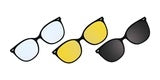
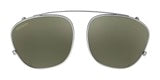
Is a small device that holds colored lenses in front our your regular prescription eyewear. The normally come in grey amber and copper.
Contrast:
Contrast is the difference in brightness between the light and dark areas of a picture, such as a photograph or video image. A high contrast lens gives you great visual acuity between light and dark areas in your view.
CR-39 (plastic):
The advantages of plastic is that it is lightweight and easily tinted to just about any color. One of the disadvantages is that those lenses scratch easily. But the biggest danger is that they are not impact resistant. If an object strikes the lens it will break into shards that could permanently damage your eyesight. For this reason we only use shatter resistant lenses in any of our sports frames.
Chromatic Aberration:
is caused by a lens having a different refractive index for different wavelengths of light (the dispersion of the lens). Longitudinal and lateral chromatic aberration of a lens is seen as "fringes" of color around the image, because each color in the optical spectrum cannot be focused at a single common point on the optical axis.
Since the focal length f of a lens is dependent on the refractive index n, different wavelengths of light will be focused on different positions. Chromatic aberration can be both longitudinal, in that different wavelengths are focused at a different distance from the lens; and transverse or lateral, in that different wavelengths are focused at different positions in the focal plane (because the magnification of the lens also varies with wavelength).
Cylinder:
If there is no value under the cylinder heading, then you have a very simple prescription. If there is a value under this heading, then you have astigmatism. The majority of optometrists write the cylinder value with a minus sign in front while the majority of ophthalmologists (physicians who specialize in the eye) write the cylinder value with a plus sign in front. Regardless of which way this is written, your glasses will be made the exact same way -- these are just two different ways to write the same spectacle prescription. Like sphere power, the cylinder power is also measured in diopters.
Day and Night (Photochromic Lenses):
New Photochromic lenses are so smart they go from clear indoors to as dark as sunglasses outdoors. Their advanced technology adjusts to changing light, so you see clearly and more comfortably in virtually any light condition.
Indoors, Photochromic lenses are as clear as your regular eyeglasses. Outdoors, they quickly darken, getting as dark as sunglasses if necessary. They work so well, in a recent clinical study, four out of five eyeglass wearers preferred Photochromic to their regular lenses, and photochromic provide 100% UV protection.
Ask your eye care professional about making photochromic lenses your every day lenses. And find out just how smart a lens can be.
Digital Surfacing:
means that the rate of curve changes from the center of the lens outward to accommodate the change in distance and angle of your eye to various points of the lens, optimizing the prescription throughout the entire lens. We have an entire page describing this technology with some of the different lens manufacturers information. Click Here
Diopter:
A unit of measurement of the optical power of lenses. For example; if a person has a prescription of -4.00, that person has 4 diopters of power in their lens. Diopters generally are measured in quarter steps like -4.00, -4.25, -4.50. Some doctors refine their measurements down to twelfth steps like -4.00, -4.12, -4.62. Diopters are also used to measure prism.
DriveWear transitional lenses:
are the first and only photochromic lenses to darken behind the windshield of a vehicle, with the ability to react to visible light as well as UV light.
By combining polarization with new photochromic technology, DriveWear lenses are capable of sensing and reacting to varying light conditions both outside and behind the windshield of the car. From bright sunlight accompanied by intense, blinding glare, to overcast inclement conditions, DriveWear lenses provide the wearer with the appropriate visual solution.
Note: DriveWear transitional lenses are not recommended for night driving as they do not change completely clear. There is a visible tint indoors as illustrated in the low light photo below.

|
||

|

|

|
|
Low light
|
Behind the windshield
|
Bright light outdoor
|
Eye size:
Is the horizontal measurement of the lens on any frame. Larger eye size fits bigger heads.
Flat Light:
When light is "flat," the slope looks like a white, empty canvas, and it's impossible to read the snow surface clearly. Ruts, bumps, ice, even rocks and thin patches disappear. And if you're out in an open expanse, it's hard to determine the pitch of the slope as your depth perception shrinks to nil.
Frame Measurements:
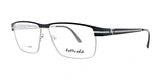
What do the numbers located on the bridge and temples of the frames mean?
Example:
The numbers on the frame reflect the SIZE MEASUREMENTS in millimeters (mm).
1st Number (ex.54) = the width of the lenses
2nd Number (ex.38) = the distance between the Top of the lenses to the bottom.
3rd Number (ex.59) = the diagonal distance of the lens
4th Number (ex.18) = the distance of the bridge between the lenses
5th Number (ex.140) = the length of the temple arm including the portion going behind the ear
G-15:
Green-Gray lenses are the most popular general purpose lenses. Uniform absorption of colors throughout the spectrum allows colors to be seen exactly as they are with approximately 85% light absorption.
Glass lenses:
One major advantage is that it is very scratch resistant. However it is double the weight of conventional plastic. Also it is not as shatter resistant or safe as plastic.
Glare:
Reflected glare by light reflected off smooth, shiny surfaces blocking vision. The number one cause of automotive accidents is glare. A polarized lens is your best defense against blinding glare.
Grilamid Nylon Frames:
No other material has the flexibility, remarkable toughness, and exceptional resistance to sun lotions. These elements allow our design team to combine the frame material's light weight, impact resistance, flexibility in variable temperature and overall comfort to create models that are durable and surpass all expectations.
High index 1.67:
Thinner and lighter than 1.60. These lenses already come with scratch coating. Also a great choice for high prescriptions.
Hyperopia:
Also known as farsightedness, is usually inherited. Children are often hyperopic which may lessen as an adult. Hyperopia is a refractive error, which results from a disorder rather than from disease. A refractive error means that the shape of your eye does not bend light correctly, resulting in a blurred image.
Impact Resistant:
Resistant to shattering or splintering. impact resistant plastic is made so that it will not break into small pieces. Polycarbonate is impact resistant making it a very safe lens to wear.
Implantable collamer lens or ICLcalled by its manufacturer Visian ICL, is a soft, flexible gel-lens used in refractive surgeries for the permanent correction of myopia (nearsightedness), made of a collagen copolymer material, named by combining "collagen" and "polymer”. The ICL procedure is a popular alternative to LASIK and PRK since it requires no removal of the corneal tissue and reportedly produces better visual results. The ICL requires no maintenance and is surgically implanted inside the eye, where it resides permanently.
Infrared (IR) Radiation (760 - 3000nm):
Infrared Rays are radiant energy, or heat waves, not considered harmful under normal conditions. These heat rays cannot be seen but can be felt. If you are exposed to intense sunlight for a lengthy period of time (a day at the beach, for example) without infrared protection, you may experience a burning or stinging sensation in your eyes and a sense of fatigue. Infrared rays can be especially discomforting if you wear contact lenses. If your sunglasses fail to stop infrared light, it can be absorbed by your contacts, causing them to "warm up".
Keratoconus:
Is a malformation of the cornea, bulging it into a cone formation similar to a football. There are a few reasons that someone could experience keratoconus. It may be due to an imbalance of enzymes within the cornea, damage from UV light from not wearing sunglasses or wearing the wrong type of contact lens causing irritation and additional damage from rubbing.
Lens Materials:
There are four types of lenses materials that we use.
Plastic or CR39 lenses cost much less, but are easily scratched and can not be used for sports or children.
Polycarbonate lenses are tougher than plastic and are shatterproof, making them ideal for sports and outdoor activities.
Glossary of Optical TermsAuthored by: Grant Lambert ABOC, Sunray Optical, Inc. |
||
|
A
|
F G
|
P
|
|
What is certification? You can't buy it; you have to earn it.
— official and public recognition of your achievement that you have met a national set of standards as a qualified and competent optician or NCLE contact lens technician. Certification is official assurance to the public that you will handle their eye wear needs competently and carefully; certification is recognized by employers as a standard of competence. This coating can be applied to the outside or inside surface of any lens (clear or sun lens) to minimizing the amount of light reflected by your lenses thus reducing annoying reflections and distracting glare which may cause headaches or interfere with vision clarity. Regular lenses reflect a very small amount of light back into your eye, possibly skewing vision; anti-reflective coating helps to prevent this anomaly. It is best used on the back surface of a sun lens to minimize back glare. Anti-Reflective Coating (Super): Anti-Scratch Coating: ANSI Standard Z87+:
Please be aware that an employee subjected to High Impact may not be adequately protected if wearing lenses tested only for Basic Impact. Description of the new ANSI testing requirements:
ANZI Side shields:
Astigmatism: What causes astigmatism? If the corneal surface has a high degree of variation in its curvature, light refraction may be impaired to the degree that corrective lenses are needed to help focus light rays better. At any time, only a small proportion of the rays are focused and the remainder are not, so that the image formed is always blurred. Usually, astigmatism causes blurred vision at all distances. Some people with very high degrees of astigmatism may have cornea problems such as keratoconus. Astigmatism is very common. Some experts believe that almost everyone has a degree of astigmatism, often from birth, which may remain the same throughout life. The exact reason for differences in corneal shape remains unknown, but the tendency to develop astigmatism is inherited. For that reason, some people are more prone to develop astigmatism than others. Axis: |
||
|
Backside anti-reflective (AR) coating: Ballistic: Base: Base Curve: |
||
